A industrial internet (Industrial Internet of Things - IIoT) is still a term that is not widely used in Brazil. It is part of Industry 4.0, a movement focused on digitizing industrial activities through data automation, artificial intelligence and interconnectivity.
With IIoTBy using the Internet, devices can be interconnected to improve productivity and reduce costs.
Despite the benefits highlighted, a survey carried out by Brazilian Industrial Internet Association (ABII) showed that only 29% of the 84 companies interviewed were aware of the topic. In addition, 65% of them did not have any programs of this type.
The continuous growth of technology in industry shows that digitalization cannot be left behind. So, in order not to be left behind and to stand out from the competition, we're going to show you how the industrial internet of things can bring advantages to your applications.
Definition of industrial internet
The industrial internet is part of the internet of things (IoT). In short, this type of technology is responsible for automating processes and making machinery increasingly autonomous.
With IIoT, all machines, equipment and software are interconnected via the internet. This makes the manufacturing process safer, more efficient and more productive.
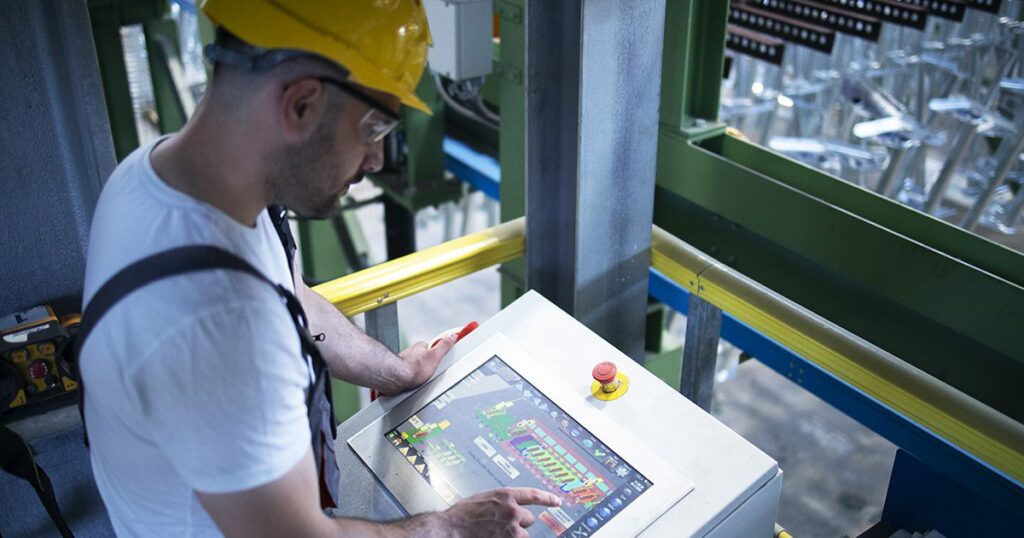
From production to logistics, it's possible to monitor real-time data on how the machines are working and how the work is progressing. This is because these devices have dedicated sensors at various stages of the processes.
Since the machinery is intelligent, it can identify problems and send information to connected users, such as management and the maintenance sector.
But in order to operate efficiently, it is necessary to invest in information technologies such as big data, cloud computing and industrial automation.
What is the difference between IoT and IIoT?
The industrial internet (IIoT) is a subcategory of the internet of things (IoT). Both are part of the industry 4.0So it has the same objective. However, there is a slight difference in application.
IIoT is used in industrial environments, with their respective communication protocols, while IoT can be used by various sectors and users, such as public bodies and medical care.
What is the focus of the industrial internet?
The main aim of IIoT is to improve company productivity through communication between machines, reducing operating costs.
Due to the intelligence applied, they are responsible for making their own decisions, based on the history of operations. As a result, they are able to predict failures and do without human intervention, a detail that guarantees employee safety.
Some of the functions that IIoT applies to machinery are:
- send and receive operational statuses in real time;
- report faults;
- report possible damage to parts;
- current application.
This makes it much easier to identify and correct future errors, so as not to interrupt production and keep deadlines on track. As a result, the industrial internet makes decision-making more assertive.
5 benefits of the industrial internet of things
Making convenient decisions is directly related to a company's efficiency. However, this is not the only advantage of IIoT.
1. Increased efficiency
IIoT improves the organization's overall performance. It therefore raises industry productivity by 30%.
2. Improved security
By anticipating failures, the equipment itself guarantees worker safety. This makes everyone feel safer - another bonus for productivity.
3. Predictive maintenance guarantee
Predictive maintenance is related to cost savings, as there will be no need to stop production or buy last-minute spare parts at high prices.
4. Energy efficiency
IIoT can also be used to manage energy in the industrial plant. This means that it identifies places where it is possible to reduce the use of electricity, bringing savings without affecting work performance.
5. Improved competitiveness
With increased productivity, reduced costs and employee safety, the company stands out from the competition, which improves its competitiveness in the market. Not to mention the opportunity for new business and revenue streams.
How to implement IIoT in industries and companies
The same survey carried out by the Brazilian Industrial Internet Association (ABII), cited at the beginning of the article, also showed that some of the challenges faced by those who want to apply IIoT in industry are the lack of suppliers and skilled labor.
But don't worry, transitioning your company to Industry 4.0 won't be a problem with SSE!
We have already helped several industries, such as Zubair project 1. In it, our professionals worked to implement corrective actions to improve productivity and the quality of the client's work.
SSE's solutions are developed using the latest technologies to interconnect and digitize production equipment. This optimizes overall plant performance and reduces operating costs.
The time to change is now: discover the services and solutions for SSE's industrial internet and get the best results!